China Doll Tour Guide

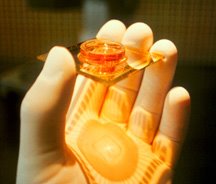
China is joining the life-size female robot race with their version of the beautiful receptionist.
(check out Korean and Japanese creations)

From Li Chengrong and others at the Chinese Academy of Sciences (CAS) Institute of Automation comes a Chinese "beauty."Li said the cost for designing and making the first robot was 300,000 yuan (US $37,500).
However, they plan to start selling the robots next year and the cost would drop to 100,000 yuan if they can sell 100 per year.
Potential customers would include star-rated hotels and entertainment clubs.

This robot is interactive and can understand and speak in a Sichuan dialect for her new job as a tour guide at Sichuan Science Museum.

Female robot to act as a tour guide

People's Daily

US Robot Orders Decline

According to statistics released by Robotic Industries Association (RIA), the robot trade group, new orders received by North American based robotics companies fell 38% in the first half of 2006.

According to the article, a 52% reduction in automotive factory robot sales is due to a cyclical turn for auto factories. Record high investments in robots over the past few years and an overall slowdown in the auto industry are both factors in the declining rate of robot hiring.

On the other hand, sales of robots to non-automotive business was down by only 5%. This raises non-auto robots to almost half (45%) of the total sales of robots so far this year. This shows the growing penetration for robots into other areas of manufacturing outside the auto industry.

RIA estimates that 162,000 robots are now installed in US factories, second only to Japan in robot use.

For first half 2006 - 6607 robots worth $473.5 million have been ordered by US companies.

Robot Sales Fall 38% in North America - Robotics Online

School of Underwater Robots Plays as a Team

Data collection this August in Monterey Bay, California will cap a three year cooperative effort involving a team of research scientists and underwater robots.
The program called Adaptive Sampling and Prediction (ASAP), was led by Naomi Ehrich Leonard of Princeton University and Steven Ramp of the Naval Postgraduate School.
The team includes scientists from all over the world and an autonomous underwater team from Woods Hole Institute and Scripps Oceanography Institute.

The objectives of the project include studying the seasonal ocean currents of the area.
The underwater robots will be able to make decisions about where to take measurements. Usually with studies like this the robots must be pre-programmed to make sure they cover the entire area. In this case the robots will decide for themselves how best to cover the interesting changes and get the most data.

The self-directed school of robot submarines may one day be able to be set free for more wideranging tasks. they could follow oil spills, fish migrations or help with military operations.

ASAP Project page


Underwater robots work together without human input

Robot Controlled by Brain in a Dish

Researchers at Georgia Tech are experimenting with home grown rat brains connected to remote robots.

A group led by Dr. Steve Potter at the Laboratory for Neuroengineering has succesfully connected lumps of living brain tissue to virtual and mechanical robots. The cells are from mammal brains, for example a rat.

The brain cells are cultured on multi-electrode arrays so there is intimate communication with the neurons. The thinking mass is then given a body via a computer interpreter.

The cells can be brought to life as a virtual creature called an animat in a video game style universe or they can be connected to moving robot bodies.

In one application the brain living in Atlanta was connected to a robot arm in Australia and allowed to express its tortured existence through art.
The resulting drawings looked like random scribblings which clearly expressed the torment of the brain during the gruesome experiement.

In other experiments the brain is embodied by a rolling robot. Researchers call these creations hybrots for 'hybrid living robot.'

The mechanical body is allowed to interact with another robot which does not have a brain and moves about randomly. The hybrots are given very simple instructions to follow or evade the other robot. The goal is to get the brain cells to perform tasks with unquestioning obedience.

So far they have not tried rat-brain-driven robots for any of the popular applications like vacuuming or bomb disposal.
Hopefully they are not working on a way to weaponize the creatures.

With fresh brains grown directly inside robots we may not have all those jobs for humans in the future after all.

Wired News: It's Alive (ish)

Friefighting Robot

The Brazilian company ARMTEC has released the latest version of its firefighting robot.

The SACI (Incidents Support Combat System) robot brings the firehose directly into the fire or sprays water or foam from 60 meters. The robot can work for 3 hours before it needs a recharge.

ARMTEC has also recently received funding to design an underwater robot for inspection oil platforsms and pipelines.
Related Posts Plugin for WordPress, Blogger...