Showing posts with label telepresence. Show all posts

Thermal Imaging Robot Finds Termites

The Australian company Termicam is testing a remote controlled robot that can crawl through nooks and crannies to track down sneaky termites munching on your house.

The Termibot uses video and thermal imaging to find the pests. Once found the robot probes the termite nest to break it open and expose the bugs. It then squirts poison directly into the nest to kill the buggers.

The prototype is connected to the human operator with an umbilical wire but future versions will be wireless.

The robot offers many advantages over traditional methods of termite control. First, the robot can go into small paces where an exterminator cannot fit. This eliminates the need to poke holes in the walls searching for the bugs. Secondly, the thermal imaging capabilities of the robot extends the human vision to be able to 'see through walls' to where the insects build their nests. Finally, the robot can deliver the insecticide directly to the nest instead of having to poison an entire house for a small infestation. This saves chemicals and reduces the stress to the environment.


Remote-controlled robot uses thermal imaging to detect and eradicate termites - gizmag Article

UK Coppers Test Sky Spy

Police in Merseyside,UK are testing an unmanned flying robot to help control the population. The BBC reports that the machine will be used "mainly for tackling anti-social behaviour and public disorder."

The unit is a small 2 pound vertical takeoff helicopter with four blades. It can have visible and infrared cameras. It can be programmed to follow a course using GPS or controlled remotely by a police officer on the ground.


The ground person watches the action from the sky high robot's point of view through video glasses display.

The robot is very quiet so you may not even know you are being watched. But it only flies for 20 minutes.

There is no word on when it will be fitted with weapons.


BBC NEWS | England | Merseyside | Pilotless police drone takes off

Robot Goes to Work For You

Last year we saw a telepresence robot that would allow a bedridden student to attend classes as a rolling video terminal. There are also robot screens that can transport a doctor to the the side of a patient's hospital bed from his office.
Now there is a startup promising a telepresence robot for teleconferencing and allowin you to be in two places at once.
Headthere is designing a remote controlled robot named Giraffe. You will be able to roll arouns the office remotely with the 5 foot 8 inch Giraffe. It has a high resolution camera with 8x zoom atop a 14 inch monitor.

Presumably you would display your own live face in the monitor, but you could display any body part there. Who knows, you might even be able to put your face with the background of say an airport terminal instead of your actual poolside scene.

The base has some obstacle avoidance capabilities and can roll over small obstacles so you could wander around a factory or move from office to conference room.
This would be perfect for the control freak or the slacker.

Headthere says that the cost will range from US $1800 to $3000 and it will be available in 2008. Just a guess that there looking for venture capital too.

HeadThere: Maker of the Giraffe Video Conferencing Robot

Robot Jockeys Amuse the Rich

A good article in Christian Science Monitor about the revitalized sport of camel racing by the introduction of robot jockeys.
Before oil, the article says, the owners of the camels would race them. After the money began pouring into the Middle East, the landowners could no longer afford to go outside of their air-conditioned homes. They began buying and selling young boy slaves to ride the camels while they cheered from the sidelines.

Finally someone from the UN told them, look, jockeys are not like camels, you are not allowed to buy and sell them. The sport went into a decline after it was forced underground.

Along came robot jockeys and to bring new life to the pastime. The sheiks can run their jockeys from the luxury of their air-conditioned SUV without the UN breathing down their necks. It turns out that the robot jockeys are much cheaper to maintain too.

From the article:
Races today – typically six miles long – feature parallel tracks. The camels – with robots dressed up in colorful cotton jerseys and jockey caps strapped on – run on the inside racetrack. And the sheikhs , owners, and trainers – piled into four-wheel drive vehicles – follow the races on an outside, paved lane, screeching instructions into the remote controls and pressing the "whip on behind" button like there was no tomorrow.


In other Middle East news...
Foster-Miller and iRobot were showing off the latest models of hazardous duty robots this month. Both the Talon and the Packbot are continuing to get improved skills in finding and disarming bombs and detecting Weapons of Mass Destruction, WMD's.

I think we should just sell the robots to sheiks instead of sending our soldiers. Let them fight their own wars. It would probably be a lot more fun for them anyway. They could chase the robots around in their Mercedes and fight their own battles without ever having to get out of their plush leather interior.


Backstory: Rein of the robo-jockey | csmonitor.com

Robot Of The Year

There have been some very significant advances in robot technology and applications this year. There is strong belief that we are witnessing the beginnings of what will become an intimate and essential part of our lives. (See Bill Gates' thoughts in Scientific American) The robot revolution has begun. We humans alive today will be both the benefactors and victims of the coming changes.

For a robot to be successful it must have the right balance of technology and utility. In selecting the Robot Of The Year for 2006 we looked for this balance.
Many of the achievements of robot science this year solved some extremely complex problems. There is no denying that the technology is advancing rapidly. However, in selecting a Robot of the Year we were looking for examples of robots that accomplished more than incremental change. We focused on robots that created a new future. We looked for robots that may have come from the future.

I guess our strict criteria is why the Robot Gossip Robot of the Year for 2006 does not come from a university research lab, government engineering project, industrial, electronics or software giant. The winner of Robot Gossip Robot of the Year for 2006 was created by an artist.

Robot Gossip Robot of the Year 2006

The Robot of the Year is Beggar (Zicar) by Slovenian artist Saso Sedlacek. It first appeared in Robot Gossip in January 2006

Beggar is described as “a robot for the materially deprived.” It is built from discarded computer parts for little or no cost. It is designed to attract and interact with people and beg for alms.


It is made from four personal computer boxes and uses CD drives for begging hands and a computer screen for its sad face.
There have been two of the robots built. The first was used in Slovenian shopping malls. The second, Beggar 2.0, practiced on the streets of Tokyo.

What makes the Beggar robot so notable is they way it combines so many of the functions for which robots are used and also brings the technology into the hands of the very common human.

Some of the functions of robots today that are fulfilled by Zicar are:

Automation- robots can replace people for boring and repetitive tasks.

Telepresence - the materially deprived owner of the beggar robot could actually operate more than one robot to leverage their efforts to more locations.

Perform hazardous and dangerous tasks - Robots are used to perform jobs where humans would be in danger. In this case the Beggar robot is stationed in an upscale mall where a human panhandler would be most certainly ejected or even arrested.

Extending human abilities - Robots are used for scaling. Generally this means geometric scaling like working on very small things inside living cells or on silicon microcircuits. Or scaling up to mine tons of ore or load cargo ships. In this case the scaling is more metaphorical. The robot extends the dignity of the beggar into the realm of the wealthy shoppers. The ‘importance’ of a homeless person is scaled up to the level of the well-to-do.


Most importantly, the robot Beggar mediates the relationship between people. Robots that form relationships with people or between people is the area where we will see the most exciting and challenging innovations for robots in the coming years. As robots move out of the factories and into our homes they will need to be able to understand and adapt to the human interface. The Beggar robot creates a more comfortable ‘user interface’ between the wealthy patrons at the shopping mall and the materially deprived person living on the fringe of society.

Congratulations to Beggar, Zicar, and to your architect Saso Sedalcek for your breakthrough creation for 2006 and your inspiration for robot designers for years to come.

Project Page
More pictures

Check back with Robot Gossip in the next few days for some honorable mention awards from 2006.

Bringing Video Game Realism to War

Pennsylvania company Chatten Associates has released their latest version of telepresence interface for military and civilian use.

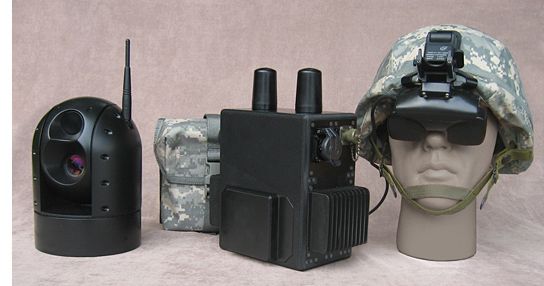
The Head Aimed Remote Viewer, HARV, is based on the eMagin Z800 3DVisor on the human operator and gimbal-mounted camera on the remote robot.
The 3DVisor fills the operator's vision as it tracks their head movements. The robot's camera exactly follows the motion of the operator's head.

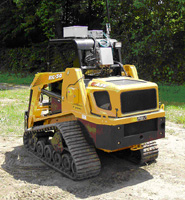
The interface has been used for explosive disposal robots and weaponized robots as well as civilian use on bulldozers. It can increase the effectiveness of the human/robot team by many times. According to Chatten, "The sense of tele-presence is so convincing that the operator’s vision processing is ”fooled“ into believing the operator is actually on the vehicle."

Chatten Associates : Human/Robotic Interfaces : Welcome

Home Robot Can See and Think

Evolution Robotics has announced that they have partnered with Japanese toymaker Bandai to give visual pattern recognition abilities to a home robot kit.
Their new creation is the NetTansor robot which was introduced last month will be available for sale in Japan in December.

The 12 inch tall robot rolls on 3 wheels and includes, cameras, microphone and speakers, and collision avoidance sensors.


The robot will be accessible remotely so that you can check on your home while you are away. Also, using the Evolution Robotics ViPR technology it will be able to recognize changes and make decisions on its own.

Advertisement
Don't forget to check out Roboteria for all you holiday robot needs.
Advertisement


For example, the robot could act as a security guard and only call you if a person enters the house. Or it could keep an eye on how much dog food is left and warn someone - you or another of your household robots - when the food is gone.

The robots also include software for games with kids that use the robot's visual recognition skills.

The ability of the robot to make decisions based on what it sees will add another level of practicality to the home robot.

Bandai and Evolution Robotics Partner on Breakthrough Telepresence Robot

Evolution Robotics is also working on home robot software for visual or navigation with Wowwee and Yujin Robotics.

UAV For Forest Fire Monitor

Spanish company Aerovision demonstrated their Fulmar unmanned flyer for use as a forest fire monitor.

The Fulmar aircraft is 3 meters wide and weighs about 20 kg (under 50 pounds)fully loaded. It is launched with a sling-shot and can stay aloft for up to 8 hours.
The Fulmar can carry both video and infrared cameras and transmit back from up to 50 km away to a base station in a laptop pc.

The flight plan, including take-off and landing, can be pre-programmed in the base station or the unit can be flown by joystick control.

The Fulmar system was designed as a low cost system for civilian applications.

AEROVISION
Related Posts Plugin for WordPress, Blogger...